

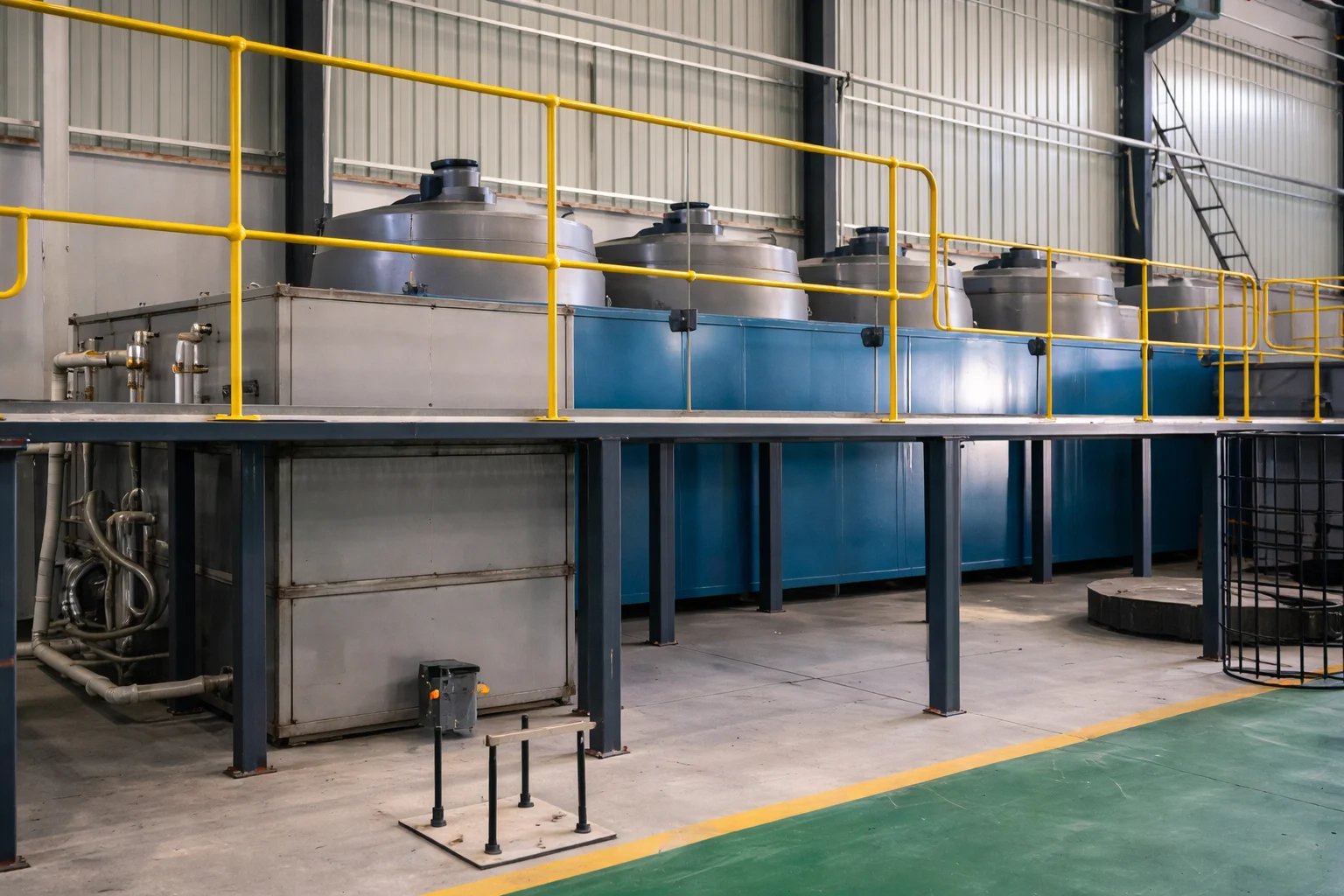
High-Performance Liquid Nitriding Furnace for QPQ Process Applications
Advanced liquid nitriding furnace manufacturer in Pune engineered for fast processing, superior surface hardness, and consistent results in high-volume production environments.
Reliable Liquid Nitriding Furnace Manufacturer in Pune
Standard furnaces struggle with:
- Inconsistent salt bath control
- Uneven surface finish
- High maintenance issues
As an experienced QPQ furnace manufacturer in Pune, we build systems that deliver:
- Uniform nitriding layers
- Faster cycle times
- Consistent black oxide finish
- Long-term operational reliability
What is a Liquid Nitriding Furnace (QPQ Process)?
It is commonly used in the QPQ process (Quench-Polish-Quench), which enhances:
- Surface hardness
- Wear resistance
- Corrosion protection
Compared to gas nitriding, the liquid nitriding furnace manufacturer in Pune offers faster processing and is ideal for batch production.
In simple terms, it’s the preferred solution when you need both performance and speed.
Key Features of Our Salt Bath Nitriding Furnaces :
That’s exactly where our furnaces stand out.
Stable Salt Bath Temperature Control
Maintains consistent conditions for uniform nitriding
Faster Processing Cycles
Ideal for industries requiring high throughput.
Uniform Surface Finish
Ensures consistent black oxide layer and improved aesthetics.
High Wear & Corrosion Resistance
Improves component life significantly.
Energy Efficient Design
Optimized insulation reduces heat loss and operational costs.
Robust Industrial Construction
Designed for continuous and heavy-duty applications.
Why Choose Raj Enterprises?
That’s why clients prefer working with us.
Process-Oriented Design
We design furnaces specifically for QPQ furnace manufacturer in Pune and salt bath nitriding applications.
Consistent Results Across Batches
Uniform treatment ensures better product quality.
Reduced Rejections
Stable process control minimizes defects.
Faster Production Output
Efficient cycles increase productivity.
Pune-Based Support
Quick response and local service advantage.
Trusted Since 2005
Strong industry experience across Maharashtra and India.
Applications of Liquid Nitriding Furnaces :
Our liquid nitriding furnaces in Pune are widely used in industries where surface performance is critical.
Common applications include:
Technical Specifications (Customizable) :
Typical configurations include:
Frequently Asked Questions :
What is the QPQ process?
QPQ stands for Quench-Polish-Quench, a liquid nitriding process that improves wear and corrosion resistance.
What is the advantage of liquid nitriding over gas nitriding?
Liquid nitriding offers faster processing and is ideal for batch production.
Which industries use salt bath nitriding furnaces?
Automotive, tooling, hardware, and precision engineering industries.
Do you provide customized furnaces?
Yes, we design furnaces based on your production and process needs.
Do you provide installation and support?
Yes, we offer complete installation and technical support.
Service Areas :
We supply liquid nitriding furnaces across:
Let’s Build the Right QPQ Furnace for Your Process
If your current system is slowing down production or causing inconsistent results, it’s time to upgrade to a furnace that delivers performance and reliability.
