

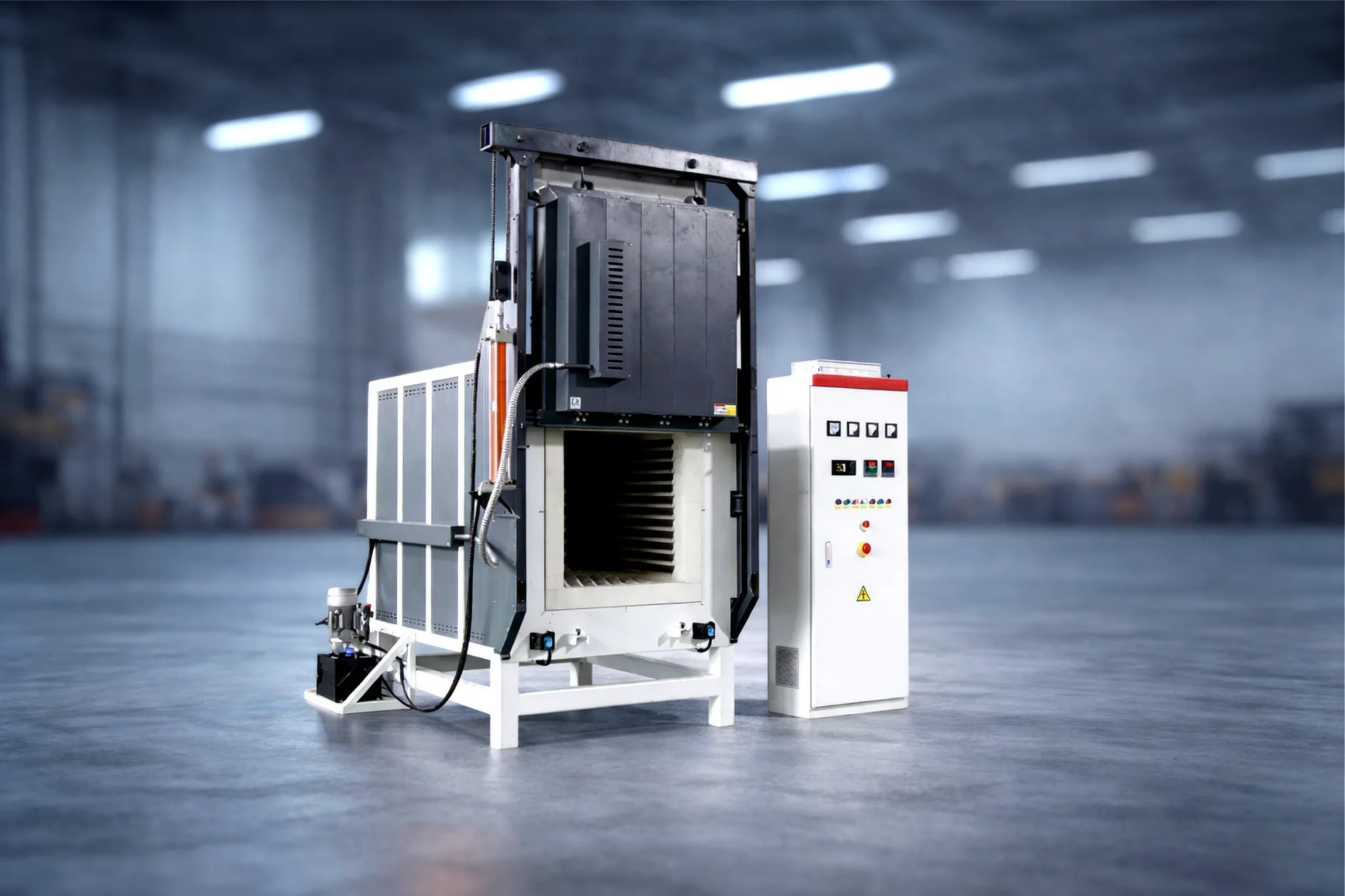
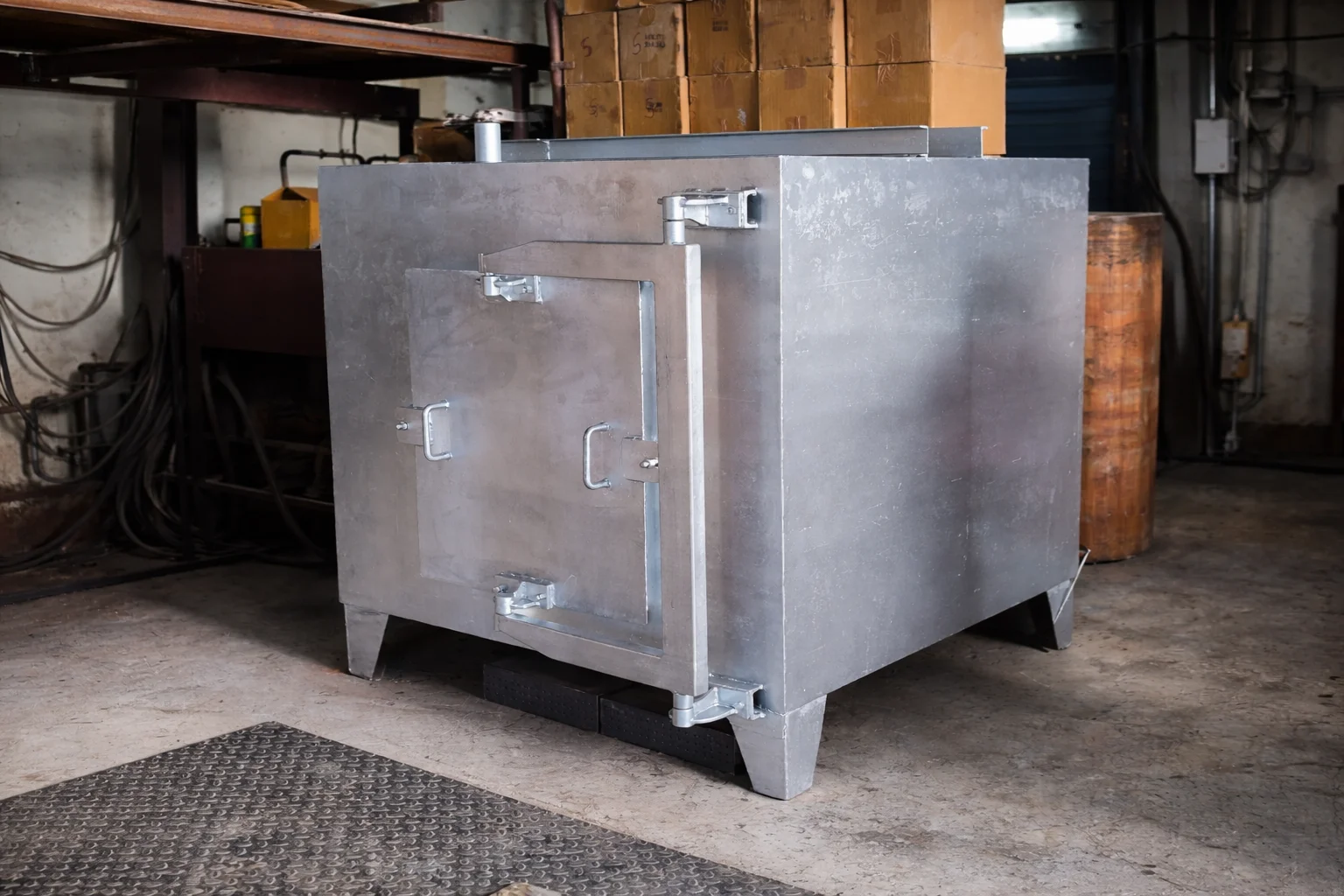
Box Type Furnace
Also we can add Trolley inside the Working Chamber
Usual Temperature - varies up to 800* C
Capacity – From 50 kg to 2500 kg, Size is customizable as per job sizes.
Heat Source – Electric, Gas & Oil
Energy Efficient structure + energy efficient control panel
Can also provide with Programmable operating through PlC, hmi, Scada.
Loading – Horizontal Resting
Why Bogie Type
- Simple Fixturing: You don't need complex hooks or "lifting eyes." You simply place the part on the hearth.
- Heavy Loads: In a Bogie furnace, the weight is transferred directly to the floor and the wheels of the trolley. This allows you to process a 50 ton engine block that would be impossible to "hang."
- Support for Fragile Shapes: For parts that are flat or have a wide base (like a large die block), resting on a flat refractory floor provides the most stable support.
Advantages :
Customizable Results
By simply changing the temperature, a metallurgist can make the same piece of steel either “springy” (high temp) or “razor-hard” (low temp).
Reduced Brittleness
It transforms “Fresh Martensite” (brittle) into “Tempered Martensite” (tough).
Improved Machinability
If a part needs minor finishing after hardening,
tempering makes it possible to work on without breaking tools.
Consistency
It ensures the hardness is uniform throughout the entire
surface of the component.
Application :
Low-Temperature Tempering (150°C–250°C)
Used for cutting tools,
bearings, and case-hardened gears where extreme surface hardness is
the priority.
Medium-Temperature Tempering (350°C–500°C)
Used for springs and
die blocks where the metal needs to “snap back” after being bent.
High-Temperature Tempering (500°C–650°C)
Used for structural
shafts, bolts, and connecting rods that must withstand heavy vibration and impact without failing.
Process in short
Cleaning : Parts are cleaned to remove quench oil, which could smoke or
catch fire in the tempering furnace.
Reheating : The parts are placed in a tempering furnace (often a pit type
or box furnace) and heated to a range between 150°C and 650°C,
depending on the desired final properties.
Soaking : The parts "soak" at this temperature to allow the internal
crystalline structure (martensite) to stabilize and relieve internal
stresses.
Cooling : Parts are usually cooled in still air. Unlike hardening, no rapid
quenching is required here.
Purpose :
The goal is to find the perfect balance between Hardness and Toughness:
Relieve Internal Stress : During quenching, steel undergoes massive
thermal shock; tempering relaxes these "stretched" atoms so the part
doesn't crack spontaneously.
Increase Ductility : It allows the metal to bend slightly under pressure
rather than shattering.
Dimensional Stability : It ensures the part won't change shape or "creep"
over time during use.
